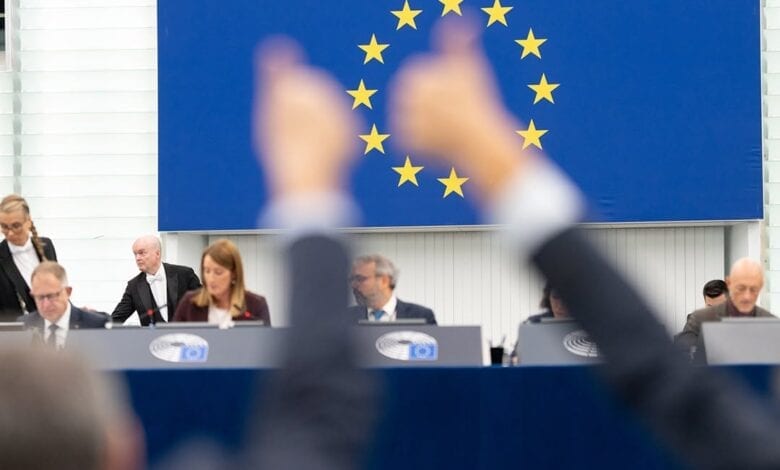
The European Parliament adopted a critical resolution on Georgia on June 17, calling on the EU and its member states to impose targeted personal sanctions on Bidzina Ivanishvili and other senior Georgian Dream leaders. The text also reiterates the parliament's non-recognition of the legitimacy of Georgia's disputed legislature and authorities, and expresses regret that Tbilisi has not taken steps to reverse what MEPs describe as an anti-European course.
The resolution was prepared by Lithuanian MEP Rasa Juknevičienė of the European People's Party. It was first debated in February, approved by the Committee on Foreign Affairs in May, and adopted in Strasbourg with 436 votes in favour, 145 against and 47 abstentions.
Sanctions, media and institutional targets
The document strongly condemns Georgian Dream-aligned outlets including Imedi TV, PosTV and Rustavi 2, accusing them of spreading systematic disinformation and hostile propaganda against the EU. MEPs urge EU institutions to follow the United Kingdom's example — London has already sanctioned two of the broadcasters — and to adopt proportionate restrictive measures against individuals and entities responsible for orchestrating and financing such campaigns, including under the EU Global Human Rights Sanctions regime.
The resolution also calls for sanctions on members and leadership of the Georgian National Communications Commission and the Georgian Public Broadcaster. It asks EU bodies to review the accreditation of the named media outlets.
MEPs adopted an amendment from the European Conservatives and Reformists group noting that insufficient academic research and public awareness about the Soviet occupation enables historical manipulation that Russia exploits to undermine Georgia's Euro-Atlantic aspirations. Amendments from the Europe of Sovereign Nations group opposing sanctions on Georgian individuals were rejected.
Democratic backsliding and electoral disputes
The resolution states that democracy, human rights and rule of law in Georgia have continued to deteriorate under Georgian Dream. It cites repression, disinformation and political harassment that MEPs say mirror Russian hybrid tactics, and expresses solidarity with Georgians seeking a European and democratic future.
The text repeats the parliament's view that the October 2024 parliamentary elections were rigged and notes that opposition parties largely boycotted municipal elections in 2025, reflecting public mistrust in the electoral process. MEPs also express concern over amendments to Georgia's Electoral Code adopted by the disputed parliament.
The resolution calls for coordinated EU-wide restrictive measures against politicians, officials and enablers deemed responsible for democratic backsliding, electoral fraud, human rights violations and persecution of opponents — including asset freezes and visa bans. It urges Hungary to lift what it describes as a blockade on sanctions against Ivanishvili and Georgian Dream.
Engagement with Georgian authorities should be strictly conditional on tangible steps reversing democratic backsliding, repression and anti-EU disinformation, the document says. MEPs repeat calls to release political prisoners, repeal restrictive laws on civil society and media — including foreign-agent legislation and broadcasting rules — and reform the High Council of Justice in line with Venice Commission recommendations.
Foreign policy alignment and regional concerns
The resolution notes that Georgia's alignment with EU foreign policy positions fell from 53% in 2024 to 40%, and expresses disappointment that Tbilisi did not systematically align with EU initiatives in support of Ukraine. It says Georgia has still not aligned with most sanctions against Russia, Belarus and Iran, and calls on authorities to prevent Georgian territory or registered entities from being used to circumvent EU measures.
MEPs express concern over Chinese state-owned involvement in strategic projects such as the Anaklia Deep Sea Port, Iran's growing economic influence, and what the text describes as Russian use of religious networks for disinformation. The resolution reiterates condemnation of Russia's occupation of Abkhazia and South Ossetia and support for the EU Monitoring Mission in Georgia.
Georgian Dream officials have previously rejected similar European criticism as interference in domestic affairs. The resolution itself does not impose sanctions; final decisions on EU restrictive measures rest with the European Council and member states.