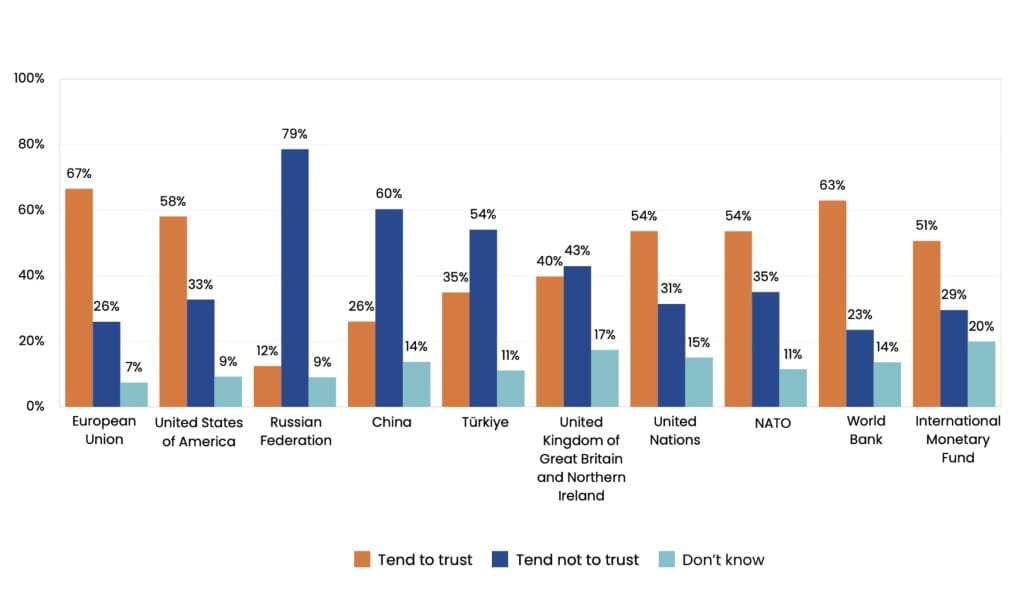
A new national survey shows that 71% of Georgians support EU accession and 67% tend to trust the European Union, even as enthusiasm for the bloc has cooled compared with recent years.
According to the poll, the share of respondents with a positive image of the EU has fallen to 40%, down from 60% in 2024. Support for membership and trust in EU institutions remain high, but the drop in overall favourability points to more mixed public mood as Georgia's accession process stalls.
What Georgians expect from membership
Respondents who back EU integration most often cited peace and security as the main expected benefits, followed by a better future for their children. Those answers reflect long-standing polling trends in Georgia, where European integration has been linked to stability, rule of law and wider economic opportunity.
At the same time, the survey recorded notable worries. Youth emigration and cultural identity ranked among the leading concerns about closer ties with Brussels. Some respondents fear that deeper integration could accelerate departures of young people seeking jobs abroad, while others question how Georgian traditions and language would fare inside a larger European framework.
Trust in international partners
The poll also asked Georgians how far they trust a range of foreign actors and institutions. Alongside the EU's 67% trust rating, the World Bank scored 63%, the United States 58%, the United Nations and NATO each 54%, and the International Monetary Fund 51%.
Trust was far lower for Russia, with 79% saying they tend not to trust Moscow and only 12% expressing trust. China recorded 60% distrust against 26% trust. Türkiye drew 54% distrust and 35% trust, while views on the United Kingdom were evenly split, with 40% trusting and 43% not trusting.
Doubts about the path forward
Despite broad support for the goal of membership, nearly half of respondents said Georgia is not moving in the right direction toward the EU. That finding sits alongside wider political tension over the pace of reforms, frozen accession talks and Georgia's alignment with Brussels on foreign policy.
Tbilisi received EU candidate status in December 2023, but progress toward opening formal negotiations has slowed amid disputes over democratic standards, civil-society legislation and alignment with EU positions on Ukraine and sanctions. Georgian Dream officials have said the country remains committed to European integration; Brussels and several member states have linked faster progress to concrete rule-of-law and institutional steps.
Why the numbers matter
For residents, expats and businesses, the survey underscores a persistent gap between public support for the European path and scepticism about how quickly or effectively authorities are delivering it. High trust in the EU coexists with falling positive image scores and concern that membership may bring social as well as economic change.
Officials and opposition groups are likely to cite different parts of the same data — strong accession backing on one hand, and frustration with the current trajectory on the other — as Georgia heads toward further domestic and international debates over its European future.